

My FILMS
I create experimental and essay films using archive footage, music, and found imagery, exploring human experience, constructed meaning, memory, and the relationship between image and reality.
Drawing on archival material and recontextualised images, my films construct new meanings through collage, editing, rhythm, repetition, and association. Rather than following conventional documentary forms, the work uses found material to explore ideas and experiences that emerge through the juxtaposition of images, sounds, and fragments of the past.
The films form an ongoing practice in experimental cinema and the essay film, with an interest in early cinema, archival imagery, and the ways images can be transformed through context.
All of my films and trailers can be viewed on my YouTube channel here.
All of my films are available to review on Letterboxd here.




JG Ballard:
DREAMS, VIOLENCE & DESIRE
This J.G. Ballard documentary assembles decades of interviews and archival material to paint a striking portrait of one of the most imaginative and provocative writers of the 20th century.
Moving through Ballard's own words, from his childhood in China to his theories of technology, violence, and desire, the film unfolds as a long-form cinematic essay rather than a conventional biography.
My aim was to follow J.G. Ballard’s own process, described in relation to The Atrocity Exhibition:
“I was interested in the process by which you could build up the image of a particular character, his obsessions, his dreams, from a whole series of apparently unrelated items: a complex of overlapping and interrelated ideas and images that come together like a kind of jigsaw.”
A bold archival exploration of Ballard's obsessions, the eeriness of his predictions, and the strange beauty of the worlds he created, a vision that continues to shape our cultural imagination.
Official screening at Embryogallery Film Festival, Sydney.
“By far; no exaggeration… your film was the one everyone was obsessed with. A new generation learned.” — Edward Quist (Embryoroom), programmer, Embryogallery Film Festival, Sydney.
If you are using this in teaching or research, please feel free to contact me.
Running time 1hr 23 mins

THE ETERNAL SILENCE
A philosophical essay film assembled from archival NASA footage.
"When I consider the short duration of my life, swallowed up in the eternity before and after, the little space which I fill, and even can see, engulfed in the infinite immensity of spaces of which I am ignorant, and which know me not, I am frightened" - Blaise Pascal (1623–1662)
Blaise Pascal (French philosopher, mathematician, scientist, inventor, and theologian) described space as an "eternal silence". He asked how do we find meaning in this infinite void?
Space exploration reaches out into that void, into the eternal silence. But what do we find there? When faced with the vastness of space why do we continue to push into it?
In Solaris (1972), directed by Andrei Tarkovsky, Dr. Snaut observes "I must tell you that we really have no desire to conquer any cosmos. We want to extend the Earth up to its borders. We don't know what to do with other worlds. We don't need other worlds. We need a mirror. We struggle to make contact, but we'll never achieve it. We are in a ridiculous predicament of man pursuing a goal that he fears and that he really does not need. Man needs man!"
When we explore space we reveal the infinite and feel true scale of our existence.
'The Eternal Silence' assembles decades of footage - from the Apollo Space landings to the optimism of the Space Shuttle era to the era of Hubble and James Webb telescopes, deep space observations beyond.
The film explores the human need to stare into the void, even as it returns nothing but silence, and the tension between our search for meaning in the face of the vastness of the cosmos.
Running time 40 min 41 sec

The Magic Lantern
The Magic Lantern is a celebration of the wonder and magic of early cinema, The film showcases the imaginative spirit of the silent film era - a time when experimentation and creativity were the very lifeblood of the medium. It captures the excitement of an era when the possibilities of film seemed endless and every frame was a discovery.
Featuring clips ranging from Eadweard Muybridge’s pioneering motion studies to early animated experiments by Émile Cohl, as well as the fantastical works of Georges Méliès and Segundo de Chomón, the film takes viewers on a mesmerizing journey through the origins of cinematic imagination. Set to evocative music by composers such as Carl Orff and Camille Saint-Saëns, The Magic Lantern is a dazzling, family-friendly exploration of creativity and visual storytelling. A treat for families and those with a passion for the history of cinema.
Reviews from X formerly Twitter:
"A charming half hour of the surreal and dream-like. Lovely idea beautifully executed. Really brings home the effect this early cinema onslaught of the fantastical must've had on minds at the time."
"The Magic Lantern is just beautiful!"
"Excellent. The vivid imagination and ingenuity are mind blowing, all artfully done. Who needs dialogue? Enjoy these tributes to early cinema. No one does them better."
"Thank you for sharing this wonderful film adventure. I enjoyed every second of it...You’re keeper of a treasure trove."
Running time 29 min 48 sec


Paranoia City: Atomic Dreams & Cold War Nightmares
The atomic bomb didn't just change warfare. It changed the American imagination.
The creation of the atomic bomb did not only unleash a destructive force—it transformed the imagination of the nation that built it, haunting its collective consciousness and giving rise to dreams, nightmares, and visions of the future.
PARANOIA CITY is a 54-minute archival essay film exploring the Atomic Age through nuclear test footage, government civil defence films, Cold War propaganda, and 1950s science fiction cinema.
Beginning with the Trinity test and the dawn of nuclear warfare, the film traces how atomic power reshaped American culture—from post-war optimism and technological utopianism to fear of annihilation, UFO panics, giant monsters, and survivalist ideology.

THE THREE STIGMATA OF PHILIP K. DICK
Enter the mind of Philip K. Dick.
This Philip K. Dick documentary takes you inside the writer's ideas about reality, paranoia, revelation, identity and alternate worlds — through Dick's own words, archival interviews, television appearances, speeches and recordings.
What if reality is not one thing?
Philip K. Dick spent his life questioning the nature of reality. His novels repeatedly return to unsettling questions: What is real? How do we know what is real? Can memory be trusted? And what happens when the world we believe in begins to fracture?
From Do Androids Dream of Electric Sheep? and The Three Stigmata of Palmer Eldritch to Ubik, A Scanner Darkly and VALIS, Dick created worlds in which reality is unstable, identities are uncertain and the boundaries between the authentic and the counterfeit begin to disappear.
But these ideas were not confined to his fiction. Throughout his life, Dick spoke about alternate realities, paranoia, revelation, identity, altered states and the possibility of multiple worlds existing alongside our own.
The Three Stigmata of Philip K. Dick takes these ideas beyond biography and into the strange territory of Dick's imagination. His own voice leads the journey, accompanied by found footage, archival film, television images and music.

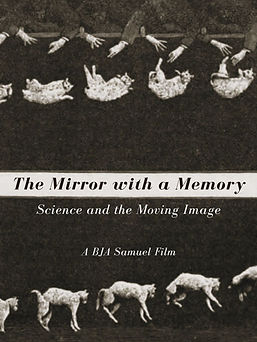
THE MIRROR WITH A MEMORY - SCIENCE AND THE MOVING IMAGE
Cinema was born from the experiments of Eadweard Muybridge (1830–1904) and Étienne-Jules Marey (1830–1904), who studied motion through photography and chronophotography. Other pioneers used cameras to study motion beyond human perception. Early scientists were fascinated by what the camera could reveal. It could break down time and uncover hidden wonders. Cinema could also show audiences science and shift public perception.
This experimental found-footage film explores scientific and archival images, from early motion studies to high-speed photography, capturing moments beyond normal perception. From the pioneering work of Eadweard Muybridge, Étienne-Jules Marey, and Harold Edgerton to contemporary imaging techniques, these fragments reveal hidden processes, extreme events, and invisible phenomena.
Running time 22 min 36 sec

1950s B-Movie Mashup!
Terrifying! Fantastic! Unbelievable! Shockingly absurd!
A loving tribute to the atomic-age madness of 1950s sci-fi and drive-in cinema.
Aliens descend from the skies. Giant monsters rampage through cities. Mad scientists reveal their plans. Heroes fire wildly into the darkness. Screaming victims flee radioactive horrors. Flying saucers circle overhead. Romance blossoms beneath the shadow of destruction.
This fast-paced mash-up brings together some of the strangest and most entertaining moments from classic cult science-fiction and horror films of the 1950s — featuring flying saucers, creature attacks, cosmic invasions, giant monsters, endless exposition dumps, hammy performances, bargain-basement special effects, and all the glorious charm of the drive-in era.
Inspired by the spirit of classic B-movies and filmmakers such as Ed Wood Jr., this film celebrates the weird imagination, sincerity, and accidental comedy of vintage sci-fi cinema.
"This might be one of the funniest videos I've seen in my life. Just the pure ineptitude and strangeness of these movies keeps getting funnier the longer you watch." - @laukosthegoblin6168

VIEW FILM HERE
For copyright reasons this film is password protected the password is:
bjasamuel
Earth Symphony
Experimental documentary film using drone footage sourced from multiple camera operators from around the world to create a view of the Earth in our time. Taking place over 24hrs the film journeys across the varied terrain of the Earth, from mountains to cites to deserts and oceans. We see the human world as a small part of a larger whole. With music from multiple composers.
"Contemplating the place of our species in the universe right now? This will be the film for you. A beautiful film with a divine score. It's almost as if drone cameras have given up on humans and gone in search of beauty."
Ewan Morrison, author of Close Your Eyes and Nina X.
"Earth Symphony holds its own amongst previous city symphony and environmental films by using drone cinematography not just to present stunning images but to also provide an elevated perspective that reveals the world's awe-inspiring symmetries."
Tico Romao Independent film scholar.
"BJA Samuel has produced a film of exemplary beauty. One that defies classification because in the strict sense of the word it is not a documentary. It is more an epic and visual airborne poem to the planet that we not only inhabit but have constructed for ourselves"
Juan Toledo, Perro Negro Magazine
"The music choices flow so well with the expansive vistas in the digital photography. Many of the shots were edited to highlight or track towards the horizon-the camera taking the viewer on a pilgrimage."
Rose Marie, Associate Professor of Humanities and Media Studies, Lecturer in Film Studies
"..stunning aerial photography from around our planet, across 24 hours. Plenty of 'wow!' moments and a great soundtrack!"
Celebrating Film
"I've watched Earth Symphony twice and will watch again (and again)."
A Mind on Fire @AMindOnFire
"I’m speechless this is so breathtaking.... truly spectacular."
Lauren @clmediaarts
Running time 1hr 15 mins
For copyright reasons this film is password protected the password is:
bjasamuel


CONSTRUCTED MEANING - A Series of Short Films
Constructed Meaning is a series of short films exploring how we try to make sense of an uncertain world.
Ghosts, conspiracies, technology, politics, memory, death, history and belief.
We find patterns.
We create stories.
We construct realities.
And then we believe them.